
The police on Saturday arrested Mr. Oli and former Home Minister Ramesh Lekhak on charges of culpable homicide during last September’s Gen Z protests.
The arrests came a day after the new government led by Balendra Shah of the Rastriya Swatantra Party was sworn in, six months after the protests in which 76 people lost their lives, including 19 in police firing on September 8.
According to police, the arrests were made to implement the recommendations of a probe commission that investigated the incidents during the Gen Z uprising.
Mr. Oli was taken into custody from his residence in Gundu, while Mr. Lekhak was arrested in Suryabinayak, Bhaktapur, a district adjoining Kathmandu.
The Gen Z protests overthrew the Oli government, in which Mr. Lekhak, a Nepali Congress leader, served as Home Minister.

Widespread protests
Tensions ran high in various parts of Kathmandu on Saturday (March 28, 2026) as members of Mr. Oli’s Communist Party of Nepal (Unified Marxist–Leninist) took to the streets. Protesters demanding Mr. Oli’s release clashed with police in Maitighar, the designated protest site in the capital. Police stepped up security in and around Singha Durbar, the government complex.
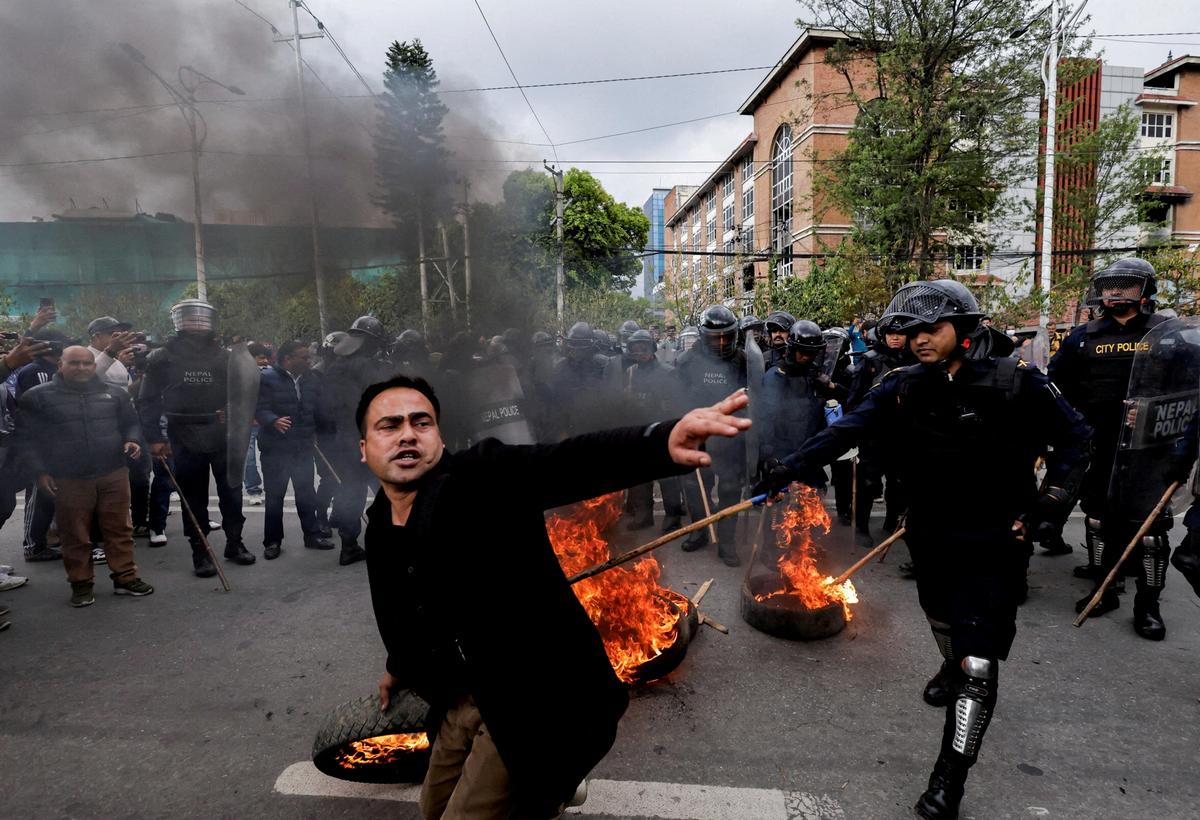
A demonstrator attempts to hurl a flaming tyre as police try to stop him during a protest following Nepal’s former Prime Minister and Chairman of the Communist Party of Nepal (Unified Marxist–Leninist) K.P. Sharma Oli detention by police in Kathmandu, Nepal, on Saturday, March 28, 2026.
| Photo Credit:
REUTERS
The commission formed to investigate the incidents of September 8 and 9 recommended that Mr. Oli and Mr. Lekhak be prosecuted for negligent killings, stating that they failed to prevent lethal police firing on the first day of the protests. The first Cabinet meeting of the new government, formed after the RSP’s landslide victory in the March 5 elections, on Friday decided to implement the commission’s report.
Home Minister Sudhan Gurung then moved quickly, holding a meeting with the chiefs of Nepal Police and the Armed Police Force late Friday night to implement the commission’s recommendations.
On Saturday morning, after police arrested the two leaders, Mr. Gurung posted on Facebook: “Aayo Gorkhali,” which translates to “Gorkhali has arrived” but carries the connotation of courage and bravery.
Through social media, Mr. Gurung also said the arrests were not an act of revenge, adding that no one is above the law.
“A promise is a promise,” he wrote. “We have taken former Prime Minister KP Sharma Oli and former Home Minister Ramesh Lekhak into custody. This is not revenge against anyone; this is the beginning of justice.”
Mr. Gurung, 38, was a key player during Gen Z’s anti-corruption protests last year, despite being a millennial himself.
Raised eyebrows
The move to arrest the two leaders, however, has raised questions, with critics saying it reeks of vendetta politics.
The probe commission, led by former judge Gauri Bahadur Karki, submitted its report to the outgoing government led by Sushila Karki on March 8, three days after the elections. However, the outgoing government did not make the report public, leaving it to the incoming administration to study before taking action.
The commission also recommended prosecution of Chandra Kuber Khapung, who was chief of Nepal Police at the time of the protests, along with other high-ranking officials. However, they have not been arrested.
When the report was leaked to the media two days before the new government was sworn in, Bipin Adhikari, a constitutional law expert, hinted at some hasty moves, including arrests, by the new government, warning of consequences.
“This government has obtained strong legitimacy through the ballot. But balancing political legitimacy with the due process of law is equally challenging,” Mr. Adhikari said on Saturday. “The implementation of the commission report should also be in line with the same parameters.”
He added, “The commission report isn’t a fast track. It calls for clarity, study, and thoughtful action — not haste.”
After his arrest, Mr. Oli, 74, who has had two kidney transplants, was taken to a hospital for a check-up, where he was subsequently admitted.
Mr. Oli’s party called the arrests illegal and driven by political vendetta. A party meeting on Saturday concluded that Mr. Oli’s arrest was against democratic principles and the rule of law.
A decision on whether to release Mr. Oli and Mr. Lekhak will be taken on Sunday after courts open, as Saturday is a public holiday in Nepal.
A lawyer said police would first need to obtain a court order approving the arrest warrants issued on Friday night, failing which the arrests could be invalidated. If the court approves the warrants, police can seek custody for investigation. Whether the two leaders remain in custody will depend on the court’s decision.
Yogesh Bhattarai, deputy general secretary of the UML, said the party would challenge the arrest in Parliament, on the streets, and in court.
“We will protest in the strongest form as our chairman Oli has been arrested unconstitutionally and illegally,” he said.
Observers have warned of potential political fallout if the new government continues to focus on misplaced priorities and actions driven by vengeance rather than rule of law.
“With regards to the arrests, the question is not why, but how,” said Hari Sharma, a political analyst. “The youth demanded clean governance and accountability, but this must be achieved through the rule of law, not rule by law.”
Published – March 28, 2026 08:00 am IST
About the Author

Discover more from InfoVera Online
Subscribe to get the latest posts sent to your email.


