
As the United States continues to tighten its blockade on Iranian oil flows, Tehran is repeatedly scrambling to manage excess crude, with its key export hub Kharg Island rapidly approaching storage limits.Tehran is now reportedly moving to expand crude storage at Kharg Island by reactivating the 30-year-old crude carrier M/T Nasha, signalling mounting pressure on its oil infrastructure as exports slow under sanctions.
The move to bring back the ageing tanker reflects a growing supply-and-demand mismatch. According to maritime analysts, Iran still has crude flowing into Kharg Island, even as outbound shipments face disruption due to restrictions, Gulf News reported.Estimates suggest that only about 13 million barrels of spare onshore storage remain, while inflows continue at roughly 1.0 to 1.1 million barrels per day. At that pace, the remaining capacity could be exhausted within nearly two weeks, pushing the terminal towards saturation.To ease the pressure, Iran has turned to floating storage, using oil tankers like M/T Nasha to hold excess crude offshore rather than relying solely on land-based facilities.
What is M/T Nasha?
The M/T Nasha is a very large crude carrier (VLCC) built in 1996 and sailing under the Iranian flag. Measuring over 330 metres in length, the vessel had remained largely inactive for years before being brought back into service.However, analysts caution that this is only a temporary solution. Floating storage is limited and costly and cannot fully replace large-scale onshore infrastructure.
Why Kharg Island is critical?
Kharg Island is the backbone of Iran’s oil economy, handling nearly 90 percent of the country’s crude exports. Located in the Persian Gulf, the island’s deep waters allow massive supertankers to dock and load oil destined mainly for Asian markets.The terminal processes crude from major offshore fields such as Aboozar, Forouzan and Dorood, making it central to Iran’s production and export chain. Any disruption or congestion at Kharg quickly translates into a national economic challenge.Despite years of sanctions, Iran has expanded storage capacity at the site, including adding millions of barrels through tank rehabilitation projects.
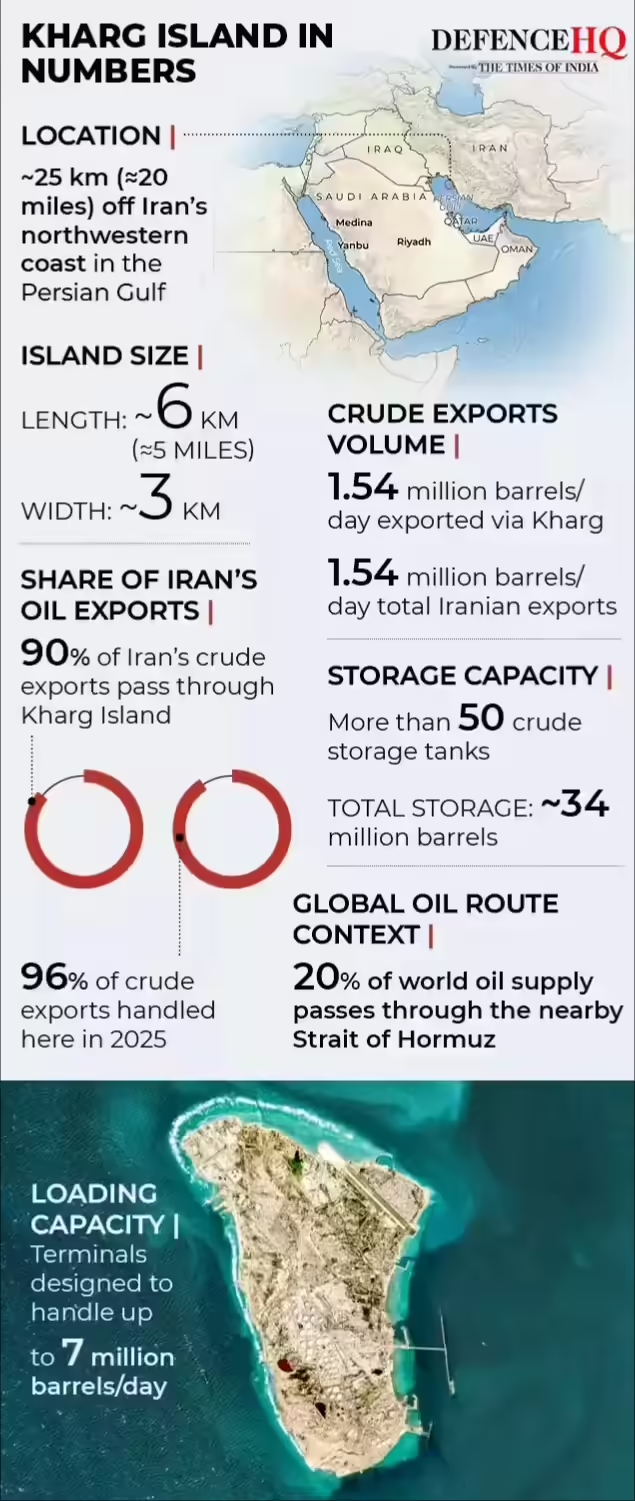
If storage at Kharg Island reaches full capacity, Iran may be forced to shut in oil wells. Such shutdowns could cause long-term damage to reservoirs and reduce future production capacity.This creates a difficult trade-off for Tehran: either cut output and risk economic losses, or continue pumping and face storage bottlenecks that disrupt the entire system.The current strain comes amid intensified US efforts to curb Iranian oil exports. Officials have made it clear that waivers allowing Iranian crude shipments are unlikely to continue, effectively tightening the blockade.Even during the ongoing conflict, Iran has kept crude moving through Kharg, with tankers continuing to load despite security risks and reported strikes in the region.While floating storage offers short-term relief, it does not solve the underlying issue of restricted exports. If the blockade persists and shipments remain constrained, Iran will eventually have to make deeper production cuts or risk damaging its oil infrastructure.
About the Author

Discover more from InfoVera Online
Subscribe to get the latest posts sent to your email.


