
Standing in the courtyard of the Qutb complex in Delhi, the Iron Pillar is one of the most extraordinary achievements of ancient Indian metallurgy. Forged during the Gupta period around the 4th or 5th century CE, the monument has stood beneath the open sky for nearly 1,600 years while showing remarkably little corrosion. Historians widely associate it with King Chandra, whom most scholars identify as Chandragupta II, the celebrated Gupta ruler who also bore the title Vikramaditya.Weighing more than six tonnes and rising over seven metres high, the pillar has fascinated generations of historians, archaeologists and scientists. Its endurance has transformed it from a royal monument into a symbol of ancient India’s scientific and engineering achievements, inspiring decades of research into the secrets behind its remarkable preservation.
The scientific secret behind the Iron Pillar’s remarkable resistance to rusting
For centuries, the Iron Pillar’s remarkable condition puzzled visitors and researchers alike. How could a massive iron structure survive nearly sixteen centuries of exposure to rain, humidity and changing weather conditions?Modern scientific research has transformed the pillar from a historical curiosity into one of the world’s most celebrated examples of ancient corrosion-resistant metallurgy. Much of this understanding comes from the work of Professor R. Balasubramaniam of IIT Kanpur, whose landmark studies published in Corrosion Science and Current Science examined the monument’s composition and corrosion behaviour in unprecedented detail.Balasubramaniam’s research revealed that the answer lies in the way ancient Indian craftsmen produced the iron. Unlike modern blast-furnace iron, the pillar contains unusually high levels of phosphorus. Ancient ironmakers used production techniques that allowed this phosphorus to remain within the metal rather than being removed during processing.The pillar itself was not cast as a single piece. Instead, Gupta-era metallurgists forged numerous iron blooms and painstakingly forge-welded them together to create the finished structure. The process required extraordinary technical skill, especially considering the monument weighs more than six tonnes and was produced more than 1,600 years ago.
The protective layer that guards the pillar
Working with metallurgist A.V. Ramesh Kumar, Balasubramaniam investigated the chemistry of the pillar’s surface and discovered the secret behind its long-term preservation.Their research showed that the phosphorus in the iron gradually helped create a protective passive film on the pillar’s surface. Over centuries, this film developed into a stable barrier that slowed corrosion and shielded the iron beneath.Scientists identified phosphate-rich compounds within this layer, including crystalline iron hydrogen phosphate hydrate. The iron also contains microscopic slag particles and unreduced oxides left behind during the forging process. Together, these features encouraged the formation of a natural protective coating that has preserved the monument for centuries.The findings were published in Balasubramaniam’s influential papers, including On the Corrosion Resistance of the Delhi Iron Pillar (2000) and On the Growth Kinetics of the Protective Passive Film of the Delhi Iron Pillar (2002), as well as his books The Story of the Delhi Iron Pillar and Delhi Iron Pillar: New Insights.
A monument to Chandragupta II ‘Vikramaditya’
The Iron Pillar is more than a metallurgical marvel. It is also a monument linked to one of the most powerful rulers of ancient India.A Sanskrit inscription engraved on the pillar praises a king named Chandra. Based on the language, script and historical references contained in the inscription, most historians identify him as Chandragupta II, the Gupta emperor who ruled during the late 4th and early 5th centuries CE and was known by the title Vikramaditya.Under Chandragupta II, the Gupta Empire expanded significantly and oversaw a period of remarkable cultural, artistic and scientific achievement. The Iron Pillar is widely regarded as one of the most enduring symbols of that era.
What is written on the pillar?
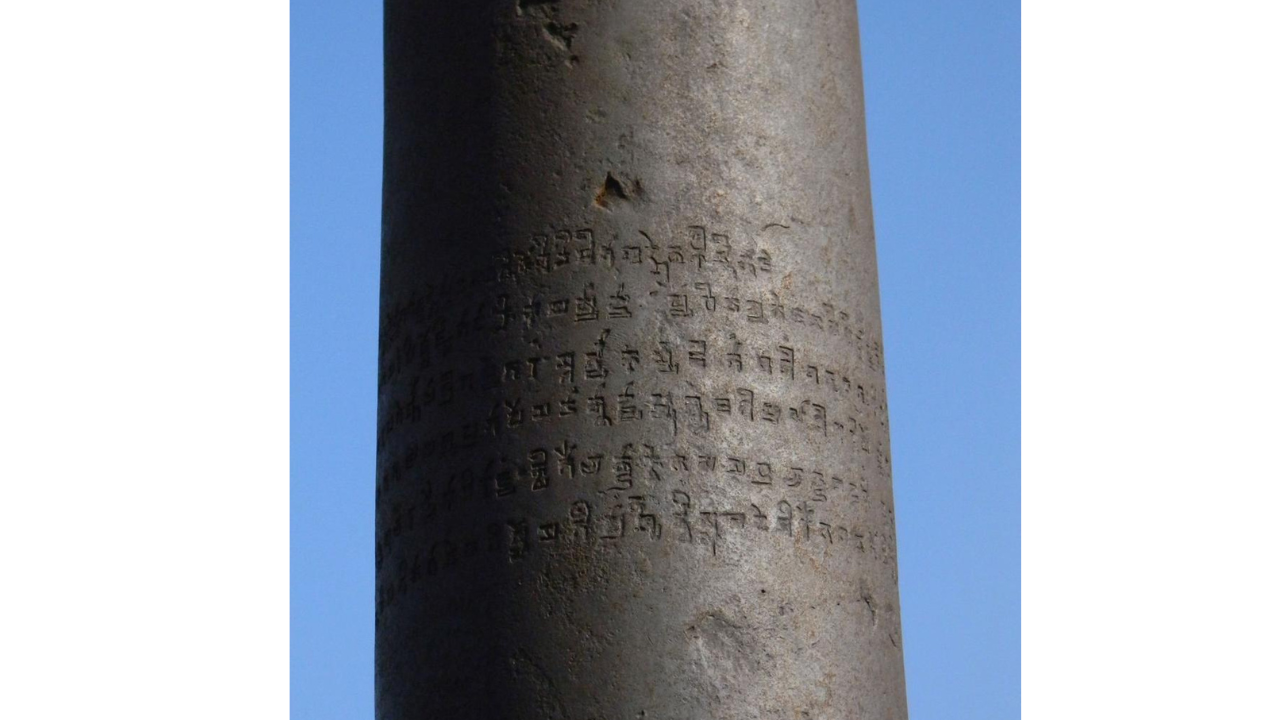
The inscription, written in Sanskrit and engraved in Brahmi script, celebrates King Chandra’s military achievements and religious devotion.According to the Archaeological Survey of India, the text identifies the monument as a Vishnudhvaja, or standard dedicated to Lord Vishnu. It also refers to a place known as Vishnupada, meaning “the footprint of Vishnu”, where the pillar was originally erected.The inscription praises the king’s victories and describes how his fame spread across distant regions. For historians, it serves as one of the most important pieces of evidence connecting the monument to the Gupta period.
Where the pillar likely began
Although the pillar now stands at the Qutb complex, scholars generally agree that it was not originally erected in Delhi.One of the strongest scholarly theories places its original location at Udayagiri in present-day Madhya Pradesh. Researchers including Meera I. Dass and R. Balasubramaniam have argued that archaeological, inscriptional and iconographic evidence points towards Udayagiri as the monument’s first home.The theory fits well with the pillar’s association with Vishnu worship and Chandragupta II, both of which were closely linked to the Udayagiri region during the Gupta period.The monument’s arrival in Delhi forms an important part of local historical tradition.Delhi’s historical traditions associate the pillar with Anangpal Tomar, the 11th-century ruler credited with founding Lal Kot, the earliest fortified settlement of Delhi. According to these accounts, Anangpal transported the pillar from its earlier location and installed it in his capital.While scholars continue to debate the precise route by which the monument reached Delhi, most agree that it originated elsewhere and was relocated centuries after its creation.Moving a six-tonne iron pillar across hundreds of kilometres of medieval India would itself have been an extraordinary engineering accomplishment.
Older than the Qutb Minar itself
The Iron Pillar had already stood for centuries before the construction of the Qutb Minar began around 1199 CE under Qutb al-Din Aibak.Its presence within the complex creates a remarkable historical overlap between the Gupta Empire and the Delhi Sultanate. While the Qutb Minar became one of India’s most recognisable monuments, the Iron Pillar remained an even older witness to the country’s history.
A living monument to ancient Indian science
For nearly sixteen centuries, the Iron Pillar has watched empires rise and fall. It stood during the age of Chandragupta II Vikramaditya, witnessed the emergence of Rajput kingdoms, survived the Delhi Sultanate and Mughal Empire, endured British rule and remains standing in independent India.Professor R. Balasubramaniam, whose pioneering research helped explain the pillar’s corrosion resistance, described it as “a living testimony to the skill of metallurgists of ancient India.” Few monuments illustrate that achievement more vividly.More than 1,600 years after it was erected, the Iron Pillar continues to stand as a symbol of India’s scientific ingenuity, engineering excellence and enduring cultural heritage.
About the Author

Discover more from InfoVera Online
Subscribe to get the latest posts sent to your email.


